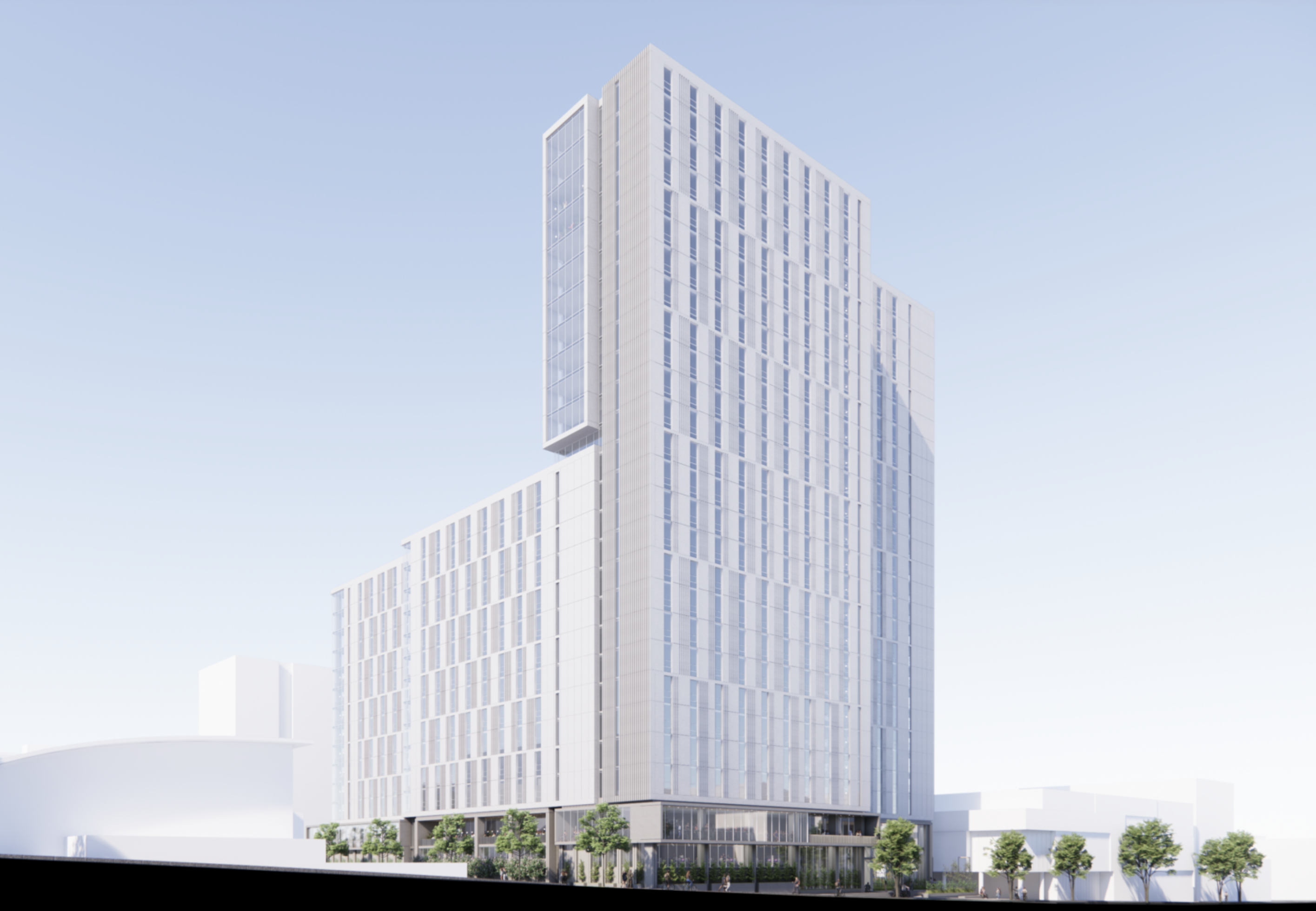
In March 2026, UC Berkeley commenced construction of a huge, 23-story tower on the corner of Bancroft and Fulton that will house 1625 first and second year students at the University. Days later the University announced plans to demolish three historic, landmarked structures to make way for an even larger, 26-story student dormitory on the site of the former Anna Head School. In its campaign to build much-needed student housing, the University appears to have adopted an architectural model in these two dorms that is a sharp break from past residences, one that will change the character of the surrounding community. How is it that the University and the City of Berkeley have arrived at this moment? The answer is complex, involving issues of increasing enrollment trends, financial deficits, ambitious city housing policies, tense town-gown relations, and University leadership that appears focused mainly on its own needs without regard to the impact on the City.
The UC Berkeley enrollment has soared in recent years according to the University’s website. With a total enrollment in 2005 of 33,558, by fall 2025 enrollment had grown by 12,593 to a total of 46,151, an increase equivalent to the enrollment of many mid-size universities. To support the students, the number of faculty and staff has grown to over 14,000. The 2021 Long Range Development Plan (LRDP) forecasts that UC Berkeley enrollment can grow at least another 3000 students by 2035. This significant enrollment growth has had a large impact on the community, its housing market, traffic congestion, and the City’s services.
UC Berkeley has historically ranked at the bottom of the ten UC System campuses in terms of its ability to house its students, providing housing for less than 30% of students. Recognizing its continued enrollment growth would only further aggravate its housing problem, UC Berkeley announced in its LRDP a plan to add some 11,000 beds. Despite this ambitious goal, by fall 2025 only approximately 2500 student beds had been added.
UC Berkeley’s on-going, three-decade financial crisis, with annual structural deficits often in the range of $150 million, provides important context to understand the University’s decisions on student housing. Despite the University’s successful fundraising, operating budgets have been cut throughout the University, and in 2025 the federal administration slashed research funding for Berkeley. Facing these financial pressures, the University has apparently placed a premium on housing projects that “pencil out” financially, and an architectural model that “bigger is better.”
The recent UC decisions to build student housing close to the core campus have further frayed town-gown relations. In 2021 the City of Berkeley sued the University to increase annual payments to compensate for the cost of city services, eventually agreeing to an annual payment of approximately $4 million, a small fraction of UC Berkeley’s annual $4 billion budget. But tensions between the City and University over enrollment, finances, and housing have left many residents feeling they are always blamed if they object in any way to the University’s plans and decisions.
The decision to destroy three landmarked buildings on the Anna Head School site exemplifies the University’s tone-deaf approach to working with the community. UC Berkeley acquired the Anna Head School through right of eminent domain in 1964, forcing its owners to move it ten miles away to Oakland. For a time, it appeared UC Berkeley would respect and cherish the legacy of the Anna Head School it had acquired. Beginning in 2008 the University conducted historic and adaptive use studies of Anna Head School, built the Martinez Commons residence on the school parking lot, and beautifully renovated three of the school’s smaller buildings. Then, in 2017, UC Berkeley appeared to abandon the Anna Head School, pursuing what one architect described as “demolition by neglect.” Professing that it “loved the buildings” but had no money, the University stood by as the buildings were ravaged by bomb cyclone rainstorms, burned by several arson fires, and soaked by faulty plumbing.
From 2020 on, a group of committed volunteers worked assiduously and carefully with the University on a plan to save Channing Hall, the original, iconic, brown-shingled school building and to build student housing. The University’s own consultants suggested a feasible model for a 14-story, 850 student residence. Instead, UC Berkeley retained Skidmore, Owings, and Merrill to design a massive structure of 26 stories, 14 higher than the nearby People’s Park dorm, for an incredible 2000 students, more than the population of most small, liberal arts colleges. The renderings of the tower appear completely out of place in the surrounding neighborhood, and the very large scale promises to create untold congestion in the area. Alas, the University turned aside all offers of help, including raising funds for the renovations. As one person observed, the UC Berkeley Chancellors, Vice Chancellor for Administration, and Campus Architect appeared to “give a stiff arm” to the community. (A full account of the effort to save the school can be found on the Anna Head School website.)
The two towers, one under construction and one planned for the Anna Head School after demolition, are a sad legacy of the University’s complex governance and failure to honor the City’s architectural heritage. Those who have worked on the Anna Head School project are great admirers of UC Berkeley and proud to live in a city with a world-class university. The citizens currently engaged in the wide-ranging discussions about housing policy in the City, including UC Berkeley’s student residences, include many who have great respect for the University. It would be well for UC Berkeley to step back and study how other leading universities have effectively managed their enrollment, student housing, finances, and town-gown relations. In so doing, there could be a more balanced and respectful relationship between the University and its local residents. And perhaps UC Berkeley would see the wisdom in building appropriate housing at Anna Head School and saving Channing Hall.
Paul Chapman, Emeritus Head, Head-Royce School, 1984-2010, Visiting Scholar, UC Berkeley, 2010-12